Wir verwenden Cookies, um Ihr Erlebnis zu verbessern. Wir benötigen Ihre Zustimmung zum Setzen von Cookies. Erfahren Sie mehr.

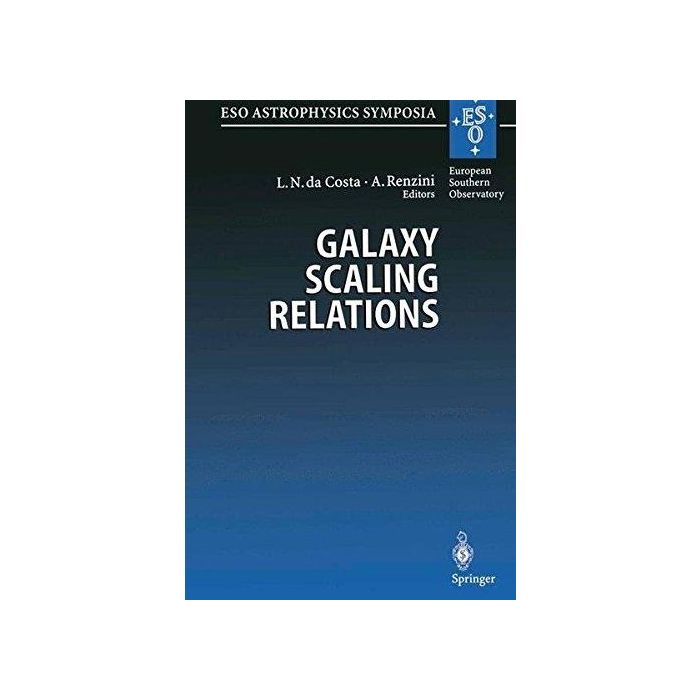
Galaxy Scaling Relations
28,99 €
Auf Lager
SKU
3540638229
Gebraucht - sehr gut
Galaxy Scaling Relations
Origins, Evolution and Applications
Luiz N. da Costa • Alvio Renzini • Editors
This book is part of the ESO conference series meant to survey the current status of different areas of astronomical research and explore science opportunities with the European Very Large Telescope (VLT). The research presented focuses on the origins, evolution and applications of galaxy scaling relations. Reviews of the properties and scaling relations of local galaxies and several reports of recent results from observations of high redshift galaxies using the Hubble Space Telescope and the Keck Telescope are also included. Current theoretical efforts to explain the origin of the observed scaling relations and the contraints imposed by the new data, as well as the use of galaxy--galaxy lensing to probe the scaling properties of dark matter halos are investigated. The book includes contributions that consider the use of the scaling relations to measure distance of galaxies and map the peculiar velocity field of galaxies in the nearby universe, as well as the constraints imposed on cosmological models from the analysis of cosmic flows.
Table of contents
The Physical Origin of Galaxy Scaling Relations - White, Simon D. M. - Pages 3-14
Can the Tully-Fisher Relation Be the Result of Initial Conditions? - Eisenstein, Daniel J. (et al.) - Pages 15-24
The Tully-Fisher Relation: A Numerical Simulator’s Perspective - Evrard, August E. - Pages 25-29
A Universal IMF: Tilt of the Fundamental Plane - Chiosi, Cesare (et al.) - Pages 30-37
The Physical Origin of the Fundamental Plane (of Elliptical Galaxies) - Ciotti, Luca - Pages 38-43
The Role of Photoionization During Galaxy Formation - Blanchard, Alain (et al.) - Pages 44-51
Semianalytic Modelling of Galaxy Evolution - Baugh, C. M. (et al.) - Pages 52-63
Dark Halo Scaling from Galaxy-Galaxy Lensing - Schneider, Peter - Pages 64-72
Constraining the Mass Distribution of Cluster Galaxies by Weak Lensing - Geiger, Bernhard - Pages 73-82
Galaxy-Galaxy Lensing in the Hubble Deep Field: the Halo Tully-Fisher Relation at High Redshift - Hudson, Michael J. (et al.) - Pages 83-92
The Fundamental-Plane and Tully-Fisher Relations Viewed in ?-Space - Bender, Ralf (et al.) - Pages 95-102
Photometric Scaling Relations of Dwarf Galaxies - Binggeli, Bruno (et al.) - Pages 103-112
The Scaling Laws of Dwarf Elliptical Galaxies - Held, Enrico V. (et al.) - Pages 113-118
Bimodality of Freeman’s Law - Tully, R. Brent (et al.) - Pages 119-125
On the Phenomenology of Disk Galaxies - Gavazzi, Giuseppe - Pages 126-131
Origin of the Colour-Magnitude Relation of Elliptical Galaxies - Arimoto, Nobuo (et al.) - Pages 132-139
Stellar Populations in Bulges of Spiral Galaxies - Jablonka, Pascale - Pages 140-145
The Luminosity-Width Relation of Spiral Galaxies - Giovanelli, Riccardo - Pages 146-157
A Comparison of Tully-Fisher and Fundamental Plane Distances for Nearby Clusters - Scodeggio, Marco (et al.) - Pages 158-163
The Infrared Tully-Fisher Relation in Abell 1367 and Cancer - Peletier, R. F. (et al.) - Pages 164-169
Calibration of the Tully-Fisher Relation: An Interim Report on the HST Key Project - Mould, Jeremy - Pages 170-174
The Fundamental Plane at z = 0.18 - Jørgensen, Inger (et al.) - Pages 175-184
Measuring the Evolution of the Mass-to-Light Ratio from z = 0 to z = 0.6 from the Fundamental Plane - Franx, Marijn (et al.) - Pages 185-196
The Near-Infrared Fundamental Plane of Elliptical Galaxies and Its Evolution - Pahre, M. A. (et al.) - Pages 197-202
Surface Brightness Evolution of Cluster and Field Galaxies - Schade, David - Pages 203-208
The Mg-s Relation of Elliptical Galaxies at Various Redshifts - Ziegler, Bodo L. - Pages 209-214
Properties of High Redshift Clus
| Verlage | Springer |
|---|
Schreiben Sie eine Bewertung
Verwandte Produkte